

Here’s an essay I wrote in my 12th-grade English class about David Macaulay and Neil Ardley’s The Way Things Work.
The Way The Way Things Work Works
As anyone who has ever done so can testify, reading textbooks is really boring. Often one finds themself going over the same paragraph over and over, reading but not comprehending anything. But in The Way Things Work (TWTW), illustrator David Macaulay shows the power of illustrations over text in creating the mental image that leads to true understanding, rather than documenting someone else’s line of reasoning. For this purpose, illustrators must understand something themselves, so that they can better explain it by drawing the “essence” of the device, rather than all its components — possibly by leaving things out or even warping the shape.
Vision is the primary sense that humans use to take in the world, and accordingly we have powerful visual-interpretation skills: we can look at a table with five apples on it, and know that there are five without needing to count them. Likewise, it’s often easy to understand a machine from a drawing, even when describing how it works in text would be cumbersome. Yet, many technical authors instinctually reach for words when creating explanations. For example, Auto Fundamentals, a well-regarded automotive repair textbook, describes the operation of a synchromesh (a component of a car’s manual gearbox) in the following way:
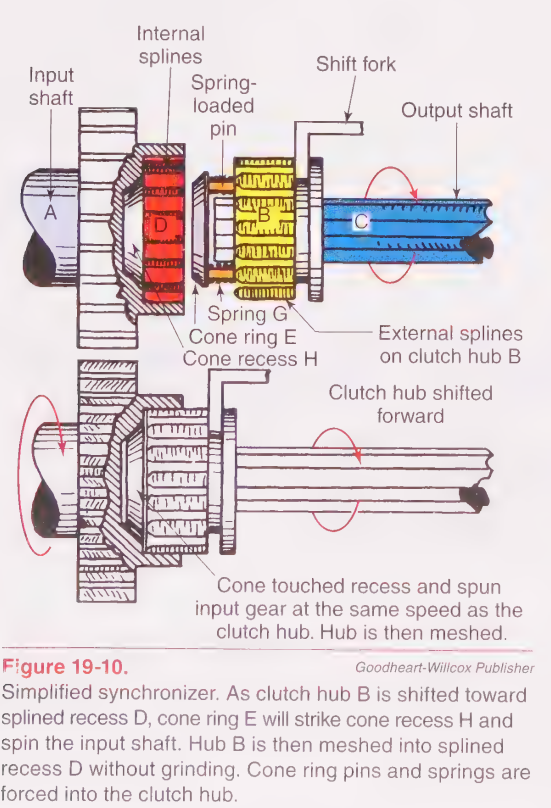
Figure 19-10 is a simplified version, illustrating the operating principle of the synchronizing device. A is the input shaft and it is stopped with the clutch disengaged. In order to mesh the spinning splined hub B on the output shaft with the splined recess D on the input shaft, it will be necessary to start turning the input shaft. Notice that cone ring E is an extension of hub B. The ring is supported on pins that fit into holes in the hub. The ring is held out by springs G.
As sliding hub B is moved toward splined recess D, ring E will touch cone-shaped bottom H of recess. As the hub is moved closer to the recess, the springs G will force cone ring E tightly against the bottom of the cone recess. As the cone ring is turning, it will impart torque to the input shaft and start it turning. As the hub moves closer, spring pressure increases and cone ring will be jammed into cone recess with enough force to spin the input shaft at nearly the same speed at which hub B is spinning. The hub may then be meshed into the recess with no grinding or shock.
(Stockel et. al. 348)
Notice how the first paragraph merely describes how the synchromesh is put together by listing different aspects of its construction. It looks and reads like an imposing wall of text: the list elements are sentences chained one after another, instead of being separated by bullet points, making it difficult to quickly reference specific points without re-reading the whole paragraph. Rather, the reader has to store all those points in short-term memory, since knowing the construction of the synchromesh is essential to understanding the second paragraph about how it works. This next paragraph reads similarly to the first, giving a step-by-step, piece-by-piece breakdown of how the synchromesh operates — almost as though the reader is meant to understand the synchromesh without needing to look at the figure. But as before, the effect of this is more to confuse than inform the reader. By the time we’ve got to the “spin the input shaft at nearly the same speed at which hub B is spinning”, we’re three long sentences away from where “hub B” was first mentioned, and we’ve forgotten what it even does!
Now, here’s the same mechanism, in TWTW:
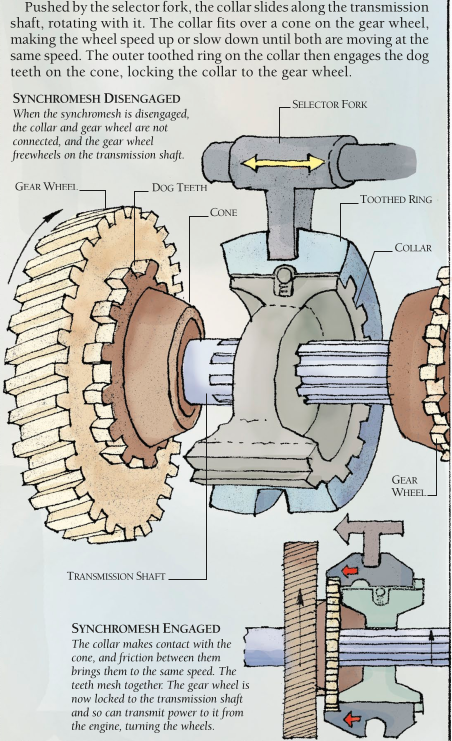
Firstly, this drawing is a lot clearer than the one in Auto Fundamentals, so much so that the synchromesh’s construction is practically self-explanatory. Whereas the figure from Fundamentals is two-dimensional, with only rudimentary hatching and line-work to suggest the 3-dimensional workings of the mechanism, Macaulay masterfully draws everything in 3-D to show without words how the mechanism is put together. There’s no need to say that the toothed ring turns with the collar — that’s apparent from the teeth connecting the two, or that they can slide separately — that’s why they’re colored differently! This also makes describing its operation much more concise; the text is used almost to “animate”, focusing on revealing the movement that can’t be conveyed by a static drawing, rather than going over what each part does. Moreover, the chunks of text are right against the drawings they describe in TWTW to promote their complementary functions, whereas in Fundamentals the figure was typeset below the text, making it more difficult to go back and forth between the two.
Thus, whereas most textbooks use drawings to support the main body of text, TWTW flips it around by using text to supplement drawings. This underscores the value of illustration in a way that perhaps isn’t fully appreciated in a culture that relegates “picture books” as childish. Although text can definitely be more precise in conveying exact ideas, and is particularly suited for conveying thoughts and reasoning, it is also basically linear, unlike most real-world concepts. As the example from Fundamentals shows, to put real-world things into words, one must cut them into strips and splice them together in hopes that the audience knows how to re-construct what you were trying to describe. Pictures and diagrams, by contrast, are much better-suited for describing complex, inter-connected systems.
Making a drawing easily-comprehensible goes beyond doing it in 3D. Macaulay reveals that illustration is a process of curating information as much as conveying it, by cutting out what’s unnecessary. Take TWTW’s depiction of an automotive differential (left), compared to the one illustrated by draftsman Ray Pioch in The How and Why of Mechanical Movements (right):
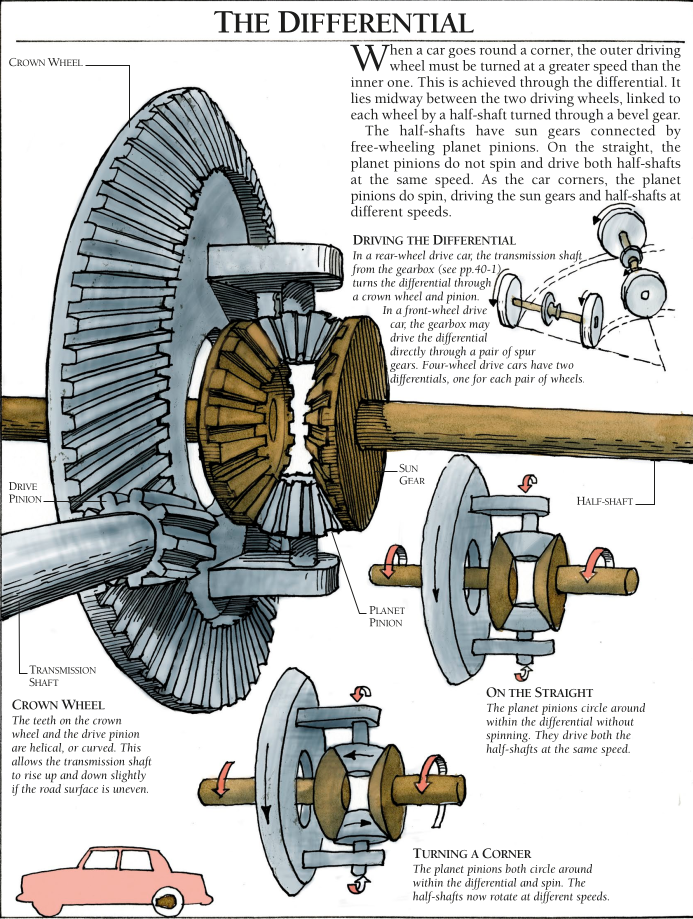
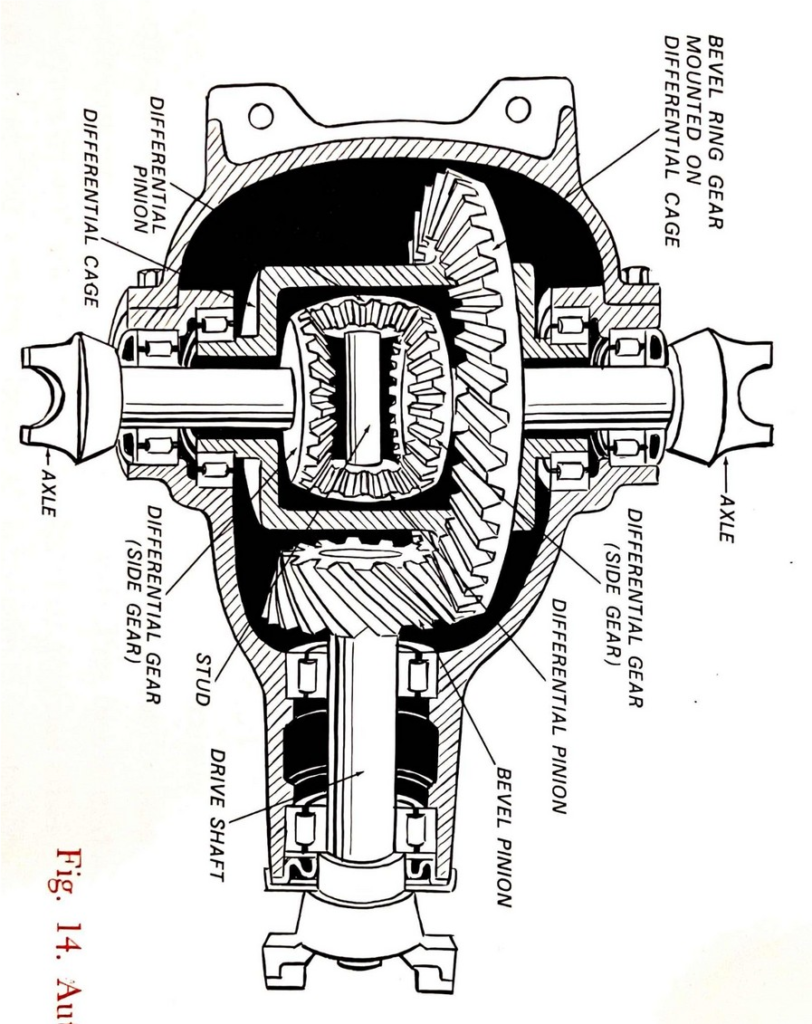
The differential from Movements is more like what’s commonly seen in textbooks: it’s done by an engineering draftsman, made to show a manufacturer how the differential is assembled. On the other hand, the one in TWTW is vastly simplified: gone are the mounting holes, bolts, bearings, and even the outer casing. Yet, simplifying the illustration makes it more effective at explaining the interaction between the gears: not only by removing visual “clutter” in the large drawing, but also by leaving room for those arrows in those smaller drawings which show how the differential moves in different situations. It is true that Movements leans more into the historical and engineering aspects of mechanisms, but both books focus mainly on showing how the individual components of a device work together — and we can see that the simplified drawing of TWTW does a better job than the more complete one in Movements.
Furthermore, TWTW will even distort things to better get at the essence of how they work, rather than their exact geometry. Take its depiction of a zipper (left), compared to a realistic cross-section (right):
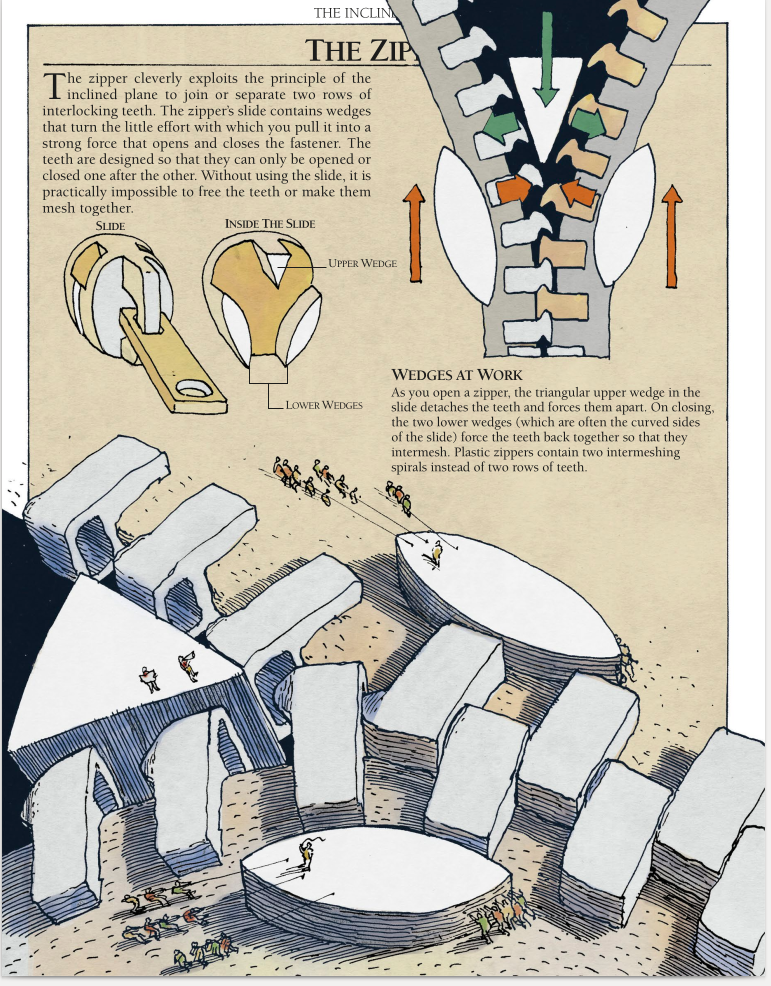
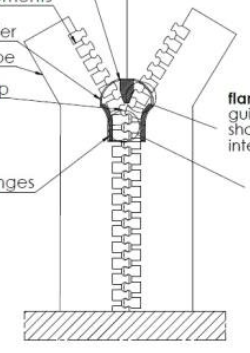
TWTW tries to emphasize that zippers work through the action of wedges, and the illustrations are designed to reinforce that idea. In most people’s minds, wedges ought to have a sort of solid, triangular shape to them; the real-life lower wedges are too thin, suggesting a sort of bendiness to them, so Macaulay draws them wider and football-shaped, instead. Likewise, the real-life wedges are curved, and have a shallow angle, so he increases their angle and removes some of the curvature to underscore how the up-down force applied to the zipper-slide is used to squeeze the teeth together or pull them apart.
Hence, Macaulay says, “Simply recording all the pieces is not enough. Illustration is a process of selection of that which needs to be seen from all that can be seen” (Caldecott Medal Acceptance). By using the understanding developed through their careful investigation of the subject, the illustrator decides what to leave out, and what to keep. So a deep understanding of how something works is just as important for explaining something through illustration, as for writing a written explanation — the only difference is how they transmit their understanding to the reader. And just like teaching forces one to re-evaluate one’s understanding and look at things in a new light, so too does drawing. Macaulay says, “Thinking — at least the lazy, day-to-day kind of thinking — often gets in the way of the drawing process, which requires a stubborn curiosity about why things look the way they do. Nothing can be intelligently or intelligibly recorded on a piece of paper unless true seeing occurs: first on the part of the person making the picture, and then on the part of the person reading it” (Caldecott Medal Acceptance). This reveals that understanding is built by thinking about something, looking closely at it, and applying one’s own reasoning (rather than others’ reasoning) to explain it to oneself. This is true for the reader as well as for the author, and it is aiding this thought process through easily-comprehensible drawings — giving a visual framework for that mental model — that makes TWTW so powerful.
Finally, It’s interesting to note how Macaulay’s lack of understanding comes across in the illustrations. In a Google Talk about TWTW, he said, “One [drawing] that I did not nail is the […] automatic transmission of a car — I drew it, I still can’t tell you how it works, but nobody’s brought it up […] but that’s the one drawing where I don’t feel I absorbed the information in the way I like to” (29:42–30:15). Here’s the drawing in question:
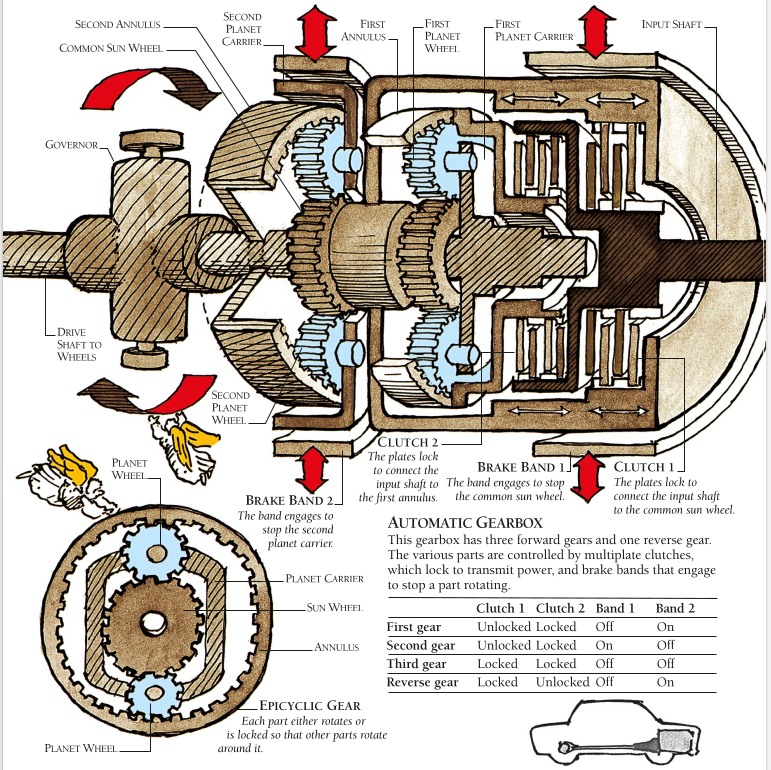
Like the other illustrations in this essay, the automatic transmission has been simplified to include only the essential components. But this drawing is more compressed — it’s harder to trace how power is transmitted through the components, reflecting Macaulay’s lack of understanding. The coloring seems off: the clutches don’t match the components they’re connected to, and most of the shafts and gears are just brown, despite turning independently. Furthermore, there are no little drawings underneath to show the different states of the transmission, a common feature in the book as a whole. Like the synchromesh from Auto Fundamentals, Macaulay resorts to naming components with letters and numbers, using text to explain what they do — in this case, using the table to show how each of the gears is achieved by operating the clutches and brake bands. But just like in Fundamentals, this is mentally cumbersome, since you have to remember what it is that “Clutch 1” and “Brake Band 2” do rather than inferring it from a purposefully-drawn picture.
In conclusion, The Way Things Work exposes something fundamental about learning: true understanding is sub-conscious — to “understand” a mechanism is to be able to spontaneously see how it works in your head, without needing to think about what each component does, and the way we build this intuition is by thinking about it. Understanding on Macaulay’s part allows him to make appropriately-simplified drawings, complemented seamlessly by text, making it easy for us to do the mental animation that forms “real” understanding in us. And while reasoning is important for learning, one must actually believe and intuitively understand the reasoning for it to be useful: it must be one’s own reasoning, not that of others.
Works Cited
- Macaulay, David, and Neil Ardley. The Way Things Work Now. Dorling Kindersley, 2016.
- Stockel, Martin W., et al. Auto Fundamentals. 11th ed., Goodhart-Willcox, 2015.
- Walton, Harry, and Ray Pioch. The How and Why of Mechanical Movements. Popular Science, 1968.
- Baharom, M. Z., Frank Delbressine, and Loe Feijs. “Kinematics Analysis of A Robotic Zipper Prototype for Miniaturization.” International Journal of Mechanical Engineering and Robotics Research, vol. 5, no. 4, 2016, pp. 305–310. https://doi.org/10.18178/ijmerr.5.4.305-310
- Macaulay, David. “Caldecott Medal Acceptance.” 1991.
- Macaulay, David. “The Way Things Work Now | David Macaulay | Talks at Google.” YouTube, 2016, www.youtube.com/watch?v=4AuTP83stbc. Accessed 21 May 2026.