
A few years ago, I went to a yard sale and bought a set of auxiliary camera lenses, which included a telephoto lens and a wide-angle lens. Unfortunately, I didn’t actually own the Canon AF35M camera they were designed for, so I was never able to use them; attempts to sell the lenses on Nextdoor and Craigslist also failed.
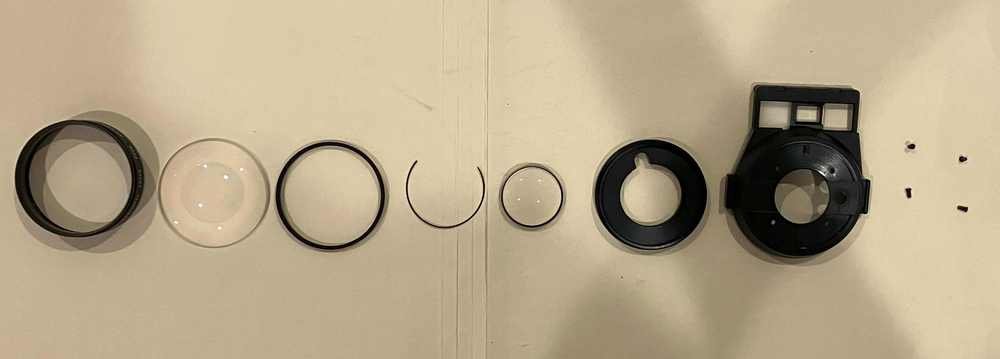
Recently I thought to take apart the lenses, and found that they were of constructed of interchangeable parts — the only differences between the two were the length of the lens tube, and of course the lens elements themselves. (The featured image shows all the parts of the lens.) By rearranging the lens elements I was able to form a fairly powerful magnifying glass.
Explanation
Basically, if we imagine a “cone” of diverging rays coming from some part the scene, with the camera lens serving to re-converge the rays onto the film, then the role of the telephoto lens is to make the cone tighter (but still diverging) before it enters the camera lens. This leads to a virtual image of the scene which is enlarged, but still at the same distance as the original scene. In other words, the telephoto lens magnifies the image, without changing its focus.
To achieve this requires a convex element (in front) and a concave element (behind), separated by some distance. If the concave element were not present, then the virtual image would appear further than the original scene, and the image “seen” by the camera would go out of focus with the lens installed. The wide-angle lens works exactly opposite to the telephoto lens, with a concave element in front and a convex element behind, serving to create a wider cone of rays, and a smaller virtual image.
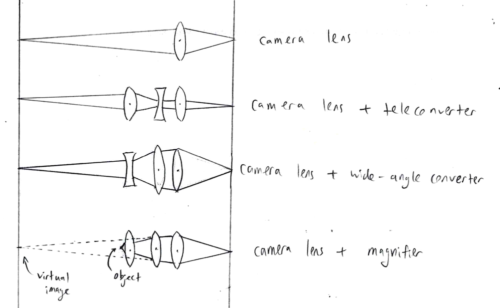
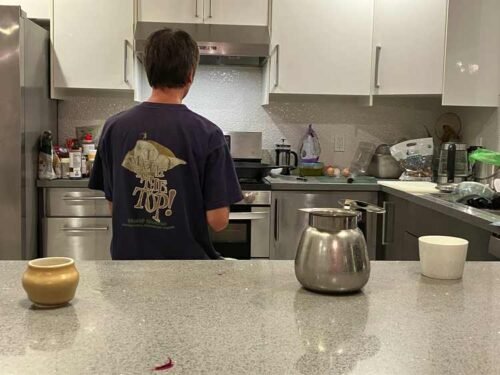
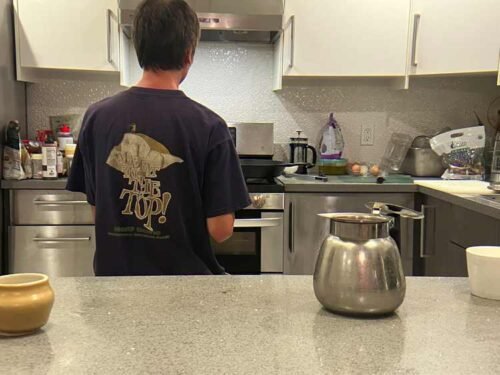
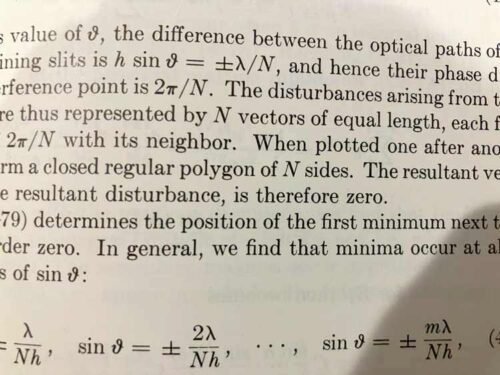
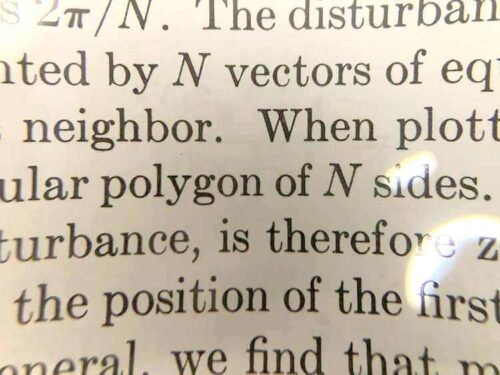
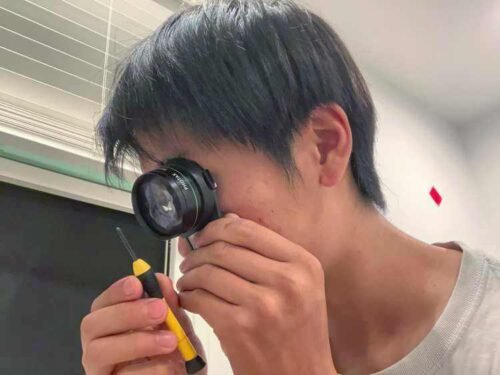
By putting together the convex front element from the telephoto lens, and the convex back element from the wide-angle lens, I essentially formed a high-power convex lens, which can be used as a magnifier.
When we want to look at a small object, we bring it as close as possible to the eye to see it better. However, the converging power of the eye limits how close the object can be brought — too close, and the object will go out of focus. When the magnifier lens is introduced, it creates a virtual image which is very large and further away, which can be easily seen.
Another potential use-case for this sort of modified auxiliary lens is as a macro lens.