
Introduction
An essential idea in finite element modelling (FEM) is convergence, the idea that as you make the simulation more and more lifelike, its results will converge to the real-life stress state. In most simulations, which mainly use single-point or rigid-body constraints, the main variable that must be converged is element size: as you make the elements smaller and smaller, the simulation will become truer and truer to reality. In this case, the procedure to obtain convergence is fairly simple:
- run successive simulations
- reducing the element size each time — for example, by halving it
- until the results — for example, the maximum stress
- converge within some amount — for example ±5%.
Recently I was trying to do contact simulations, which requires converging three main variables: mesh size, and also contact stiffness and clearance adjustment. Contact stiffness describes the pressure that pushes apart two intersecting bodies in the simulation; in real life, contact pressure is infinite, and things can’t intersect at all. Clearance adjustment describes how much the FEM is able to slightly warp the bodies’ geometry to make the mesh solve; in real life clearance adjustment is zero.
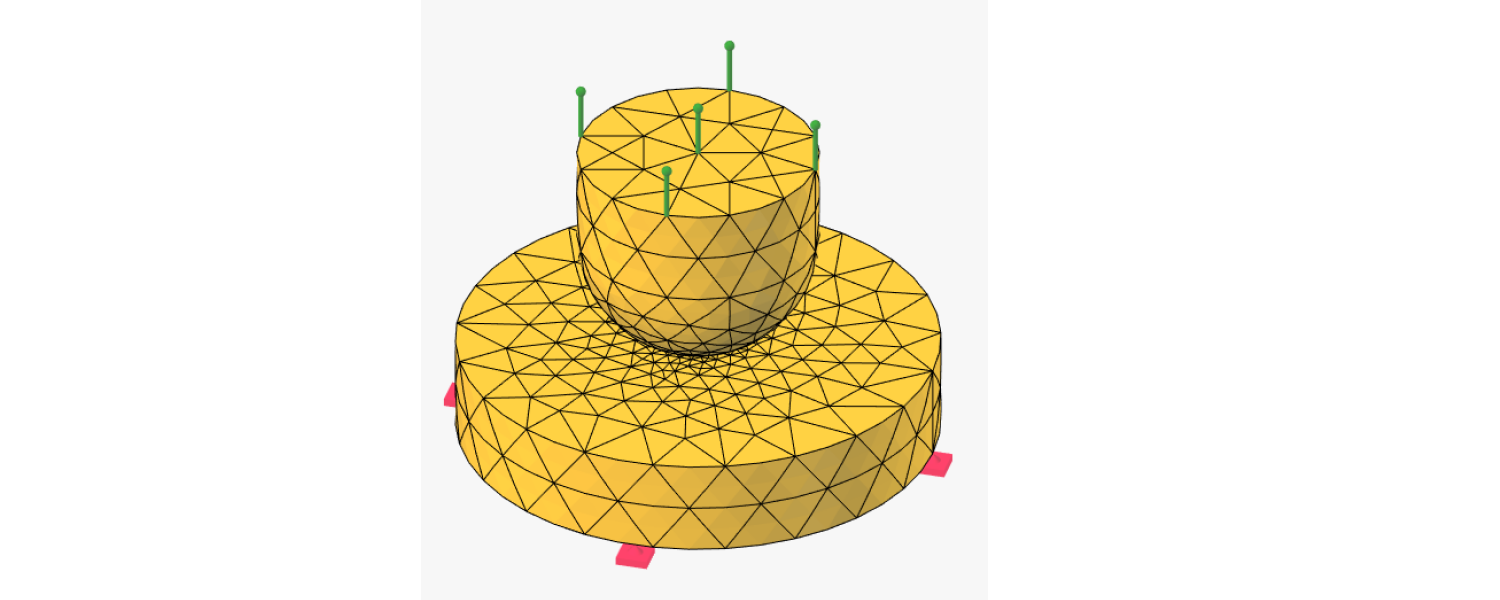
This blog post presents some studies I did to determine how the three variables affect each other in a simple contact simulation. The simulation consisted of a spherical indenter, 5 mm in diameter, pressed with a force of 100 N onto a flat plate, both made of 6061-T6 aluminium (E = 68.90 GPa, ν = 0.33). In this situation, Hertzian contact theory predicts a maximum shear stress of 505 MPa. In the simulation, the mesh was refined in the small circular region surrounding the contact areas of both indenter and plate. Simulations were done in the FreeCAD FEM workbench.
Results


Discussion
- Clearance adjustment:
- As clearance adjustment decreases, the model becomes more converged, and stress decreases.
- In this model, stress converges to zero after a certain point (0.5 μm), the converged stress being equivalent to the stress simulated at a clearance adjustment of 0.
- If element size is too large and clearance adjustment is too small, then the model will not solve at all. Element size must be reduced as clearance adjustment decreases.
- I found that, as load and deformation increase, element size needs to be decreased by less.
- As contact stiffness increases, the clearance adjustment needed to achieve convergence is decreased
- As clearance adjustment decreases, the model becomes more converged, and stress decreases.
- Element size:
- As element size decreases, the model becomes more converged, and stress increases.
- In this model specifically, no reductions in element size, beyond those needed to converge clearance adjustment, were needed to achieve convergence. I don’t know if this can be generalized to other models.
- Contact stiffness:
- As contact stiffness increases, the model becomes more converged, and stress increases.
- If clearance adjustment is not converged, then contact stiffness will not converge.
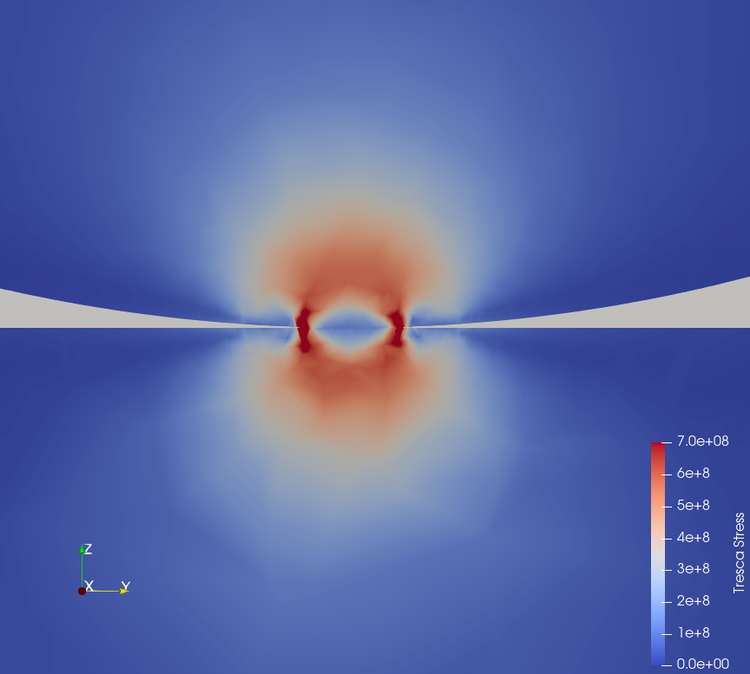
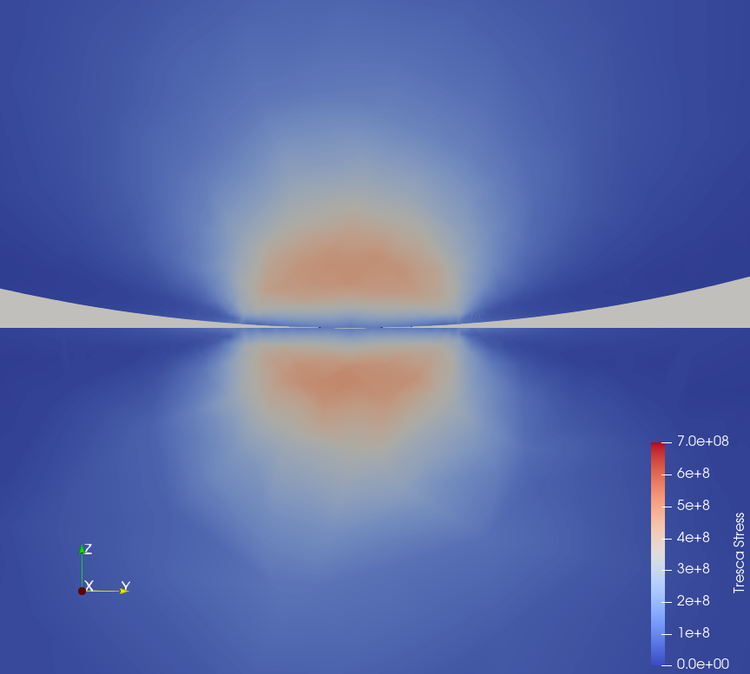
If we examine the stress distributions of simulations with high and low (i.e. converged; equivalent to zero) clearance adjustments, we see that at high clearance adjustment, the part gets warped to produce high stresses at the edges of the contact area. This is completely different from the real-life stress distribution, which is closely approximated by the simulation with converged clearance adjustment.
UPDATE: 2026-09-24
To make contact simulations faster and more efficient, these additional two settings should be set:
- Following Dominique Madier’s advice in Practical Finite Element Analysis for Mechanical Engineers, the mesh size on the “slave” object (the ball, in this case) should be finer than on the “master” object (the plate). I found that making the slave twice as fine worked well.
- When running a convergence study, cutbacks should be turned off. On the Calculix solver object:
- “Iterations Control Parameter Cutb” should be set to “0.25,0.5,0.75,0.85,,,1.5,”
- “Iterations Control Parameter Iter” should be set to “4,8,9,16,10,4,,0,,”
- “Iterations Control Parameter Iter” should be checked “yes”
- See p. 426 of the Calculix CrunchiX User’s Manual version 2.17 for what each of those numbers means.
- A “cutback” is when the solver reduces the contact stiffness to try to get the model to solve. This is undesirable in a convergence study, where the goal is to manually control element size, clearance adjustment, and contact stiffness.
