
In this blog post, I detailed several ways of using backyard clay. The method that produced the best results was levigation, in which clay was suspended in water while impurities floated to the top or settled out. The clay-water was poured off and allowed to settle for a long time, after which the water was poured off from the settled clay.
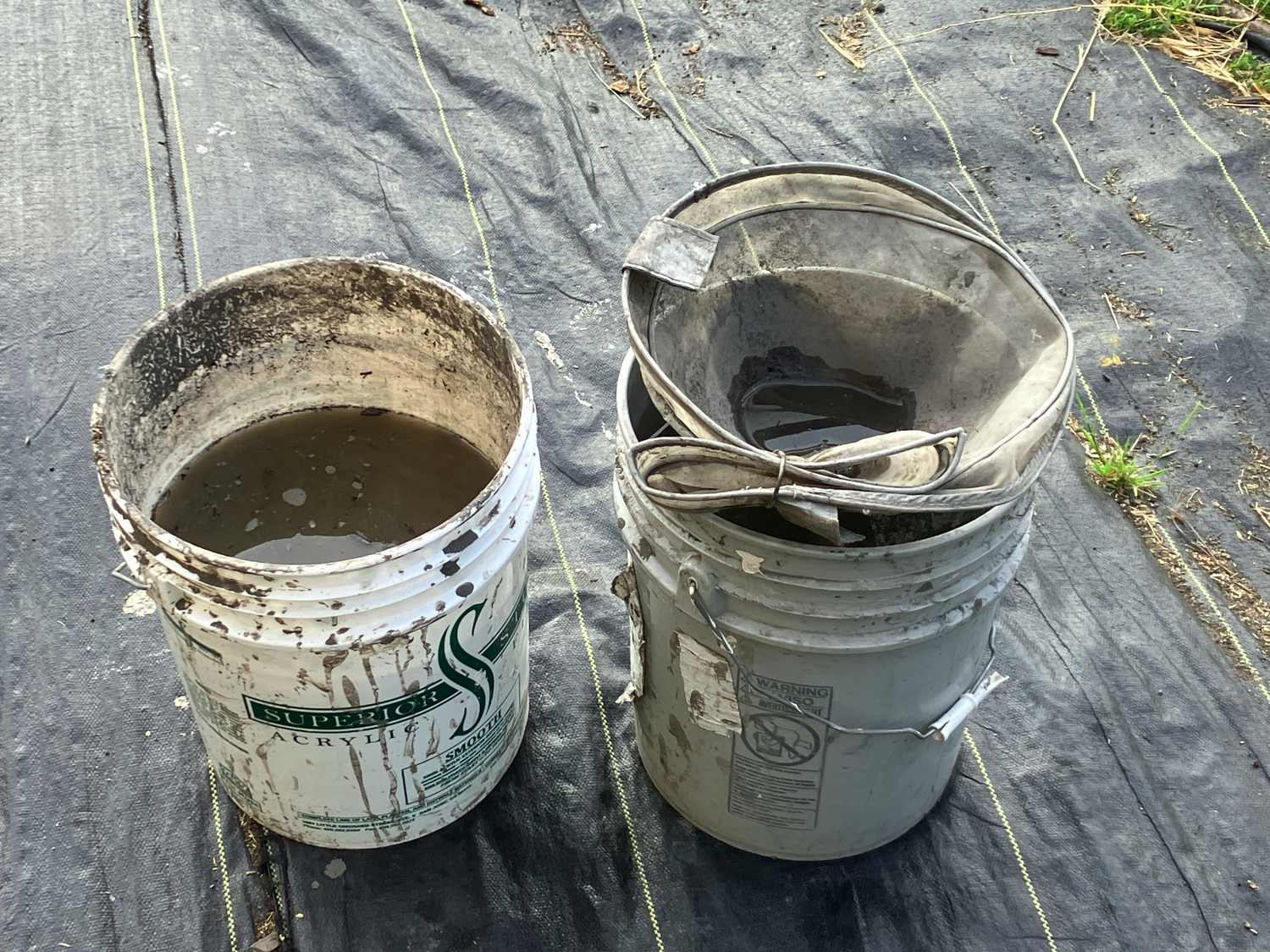
My mistake was severely underestimating the amount of clay that can be suspended in water. I initially thought that it worked something like the dissolution of ionic compounds, where clay particles go into suspension until the water can hold no more. In actuality, clay undergoes a gradual transition from brittle, to plastic, to liquid as more and more water is added. It turns out that you can fill a bucket about 3/4 full of soil, then to the brim with water to obtain a very thick clay slip. For some reason, larger bits of clay and sand can also get suspended without settling out (maybe because they are neutrally buoyant in the slip), so it is necessary to filter the slip through a fine screen. Then, the slip can be settled out, the extra water poured off, and the clay dried in the sun.
Depending on the source of soil, the significant amount of “stuff” left behind on the screen may be suitable for other purposes. I found that if the soil is more or less free of organic material, it consists of clay with a lot of sand, giving it strong drying-crack-resistant properties. I may try to use it to make permanent molds for casting, where extreme porosity is helpful.
UPDATE: 2026-06-27
I was using some of the clay that I purified over a year ago by this method, and found that one batch of the clay was not so purified as I’d like, and contained a lot of little white particles which were visible against the darker-colored clay. When performing a sedimentation test of this clay, the particles settled at the bottom, and could be identified visually, and by poking them with a stick to feel their gritty texture.
I’m not entirely sure why only one batch had these particles; it might have to do with the ratio of clay to water. As a quality-control test to avoid this issue in the future, it might be a good idea to pour out some of the purified slip for a sedimentation test, before drying it. Alternatively, one might feel around the bottom of the bucket for the gritty-textured particles.
I also found that the dry clay is much easier to handle when in the form of thin chips (< 5 mm thick), as compared to large chunks.
One response to “A Much Better Way of Purifying Clay”
[…] of dried clay, purified by levigation, were ground into very fine powder using a food grinder and sieved to remove larger pieces that […]