-

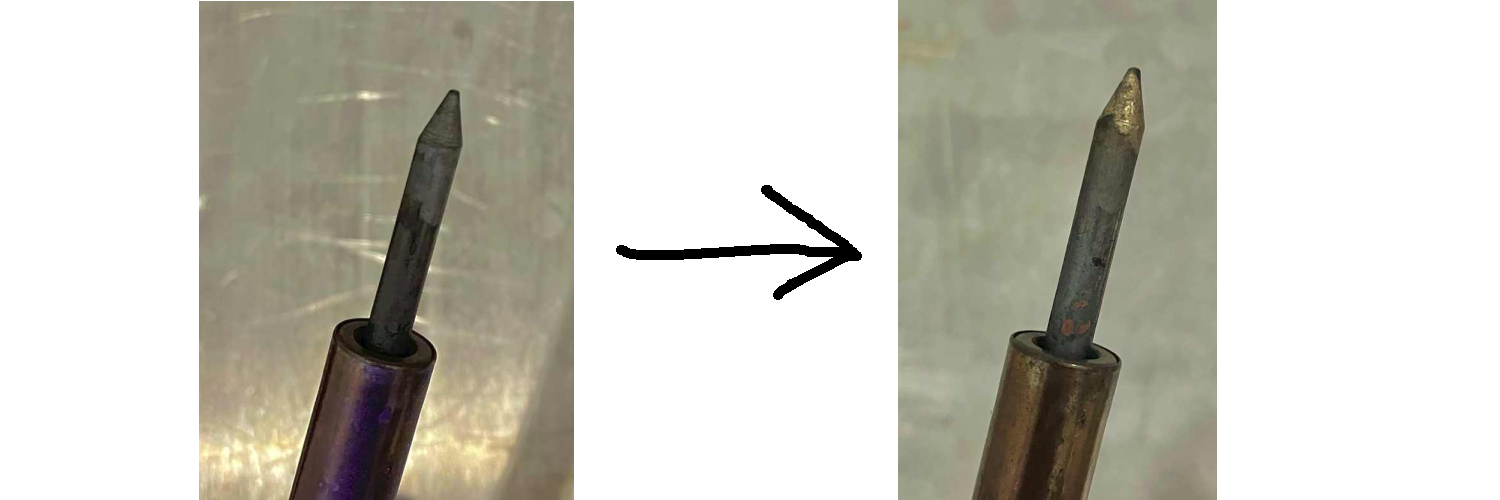
A common flux in soldering is zinc chloride solution. It is supposedly quite effective, though its corrosiveness makes it unsuitable for electronics. I tried using it as a tip cleaner for soldering irons that had oxidized to the point where they couldn’t be tinned with rosin-core solder. Zinc chloride (ZnCl2) is easy to make by yourself by dissolving zinc (Zn) in a jar of muriatic acid (HCl, 10M). The reaction was very vigorous for the first few minutes; the glass jar got noticeably warm, and steam came out of the jar. After a few hours I could still …
-

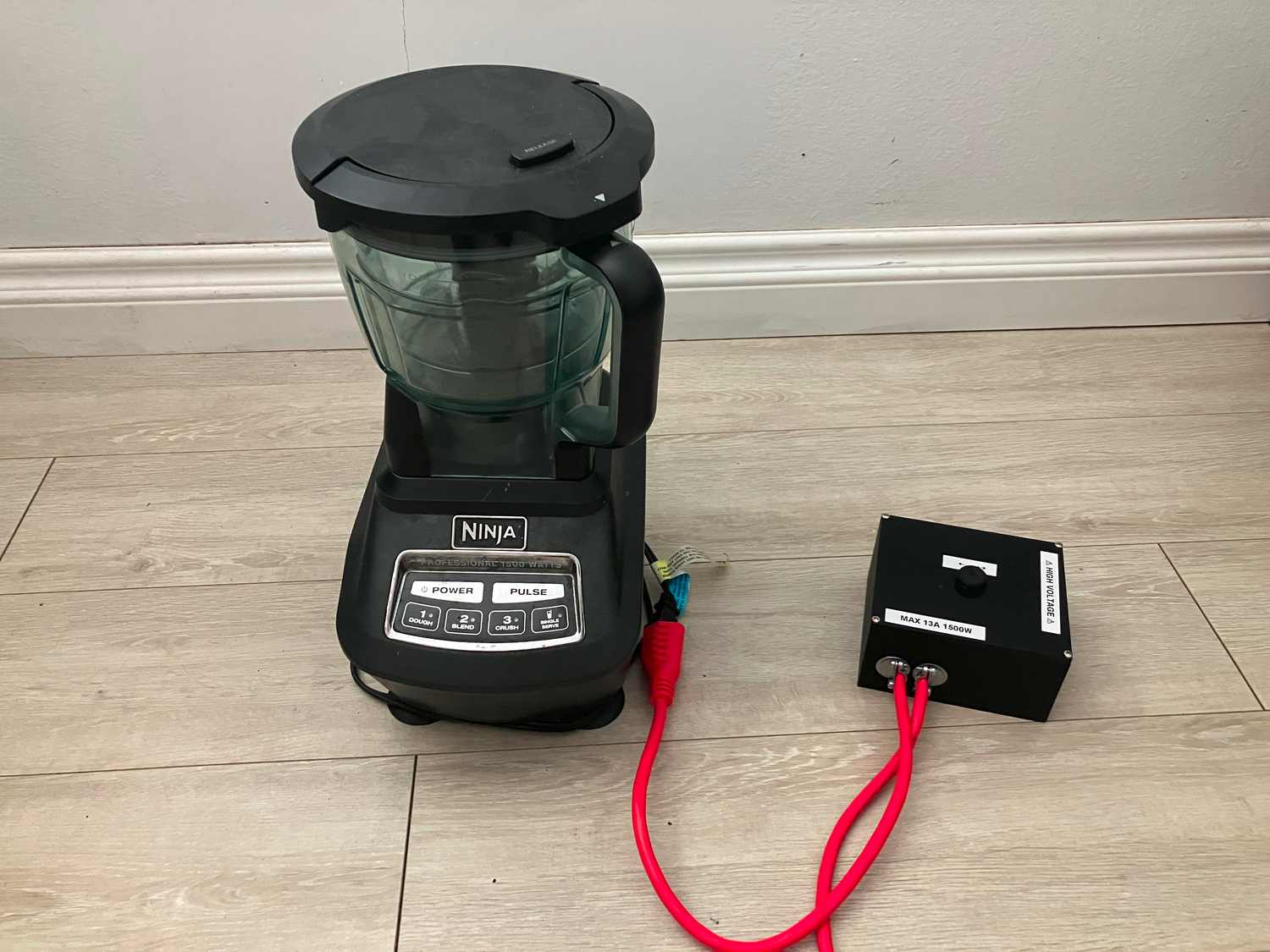
One of the greatest advantages of AC power over DC is the ability to change its voltage by way of a transformer. However, transformers are bulky and expensive, especially variable transformers that allow household AC voltage to be lowered to throttle various electronic devices. But you can cheat: instead of varying the voltage, you can switch the power on and off to “chop off” part of each AC half-wave, effectively varying the voltage (though the output is not perfectly sinusoidal), with results that are good enough for many applications. Theory I found this very helpful article describing most of the…
-

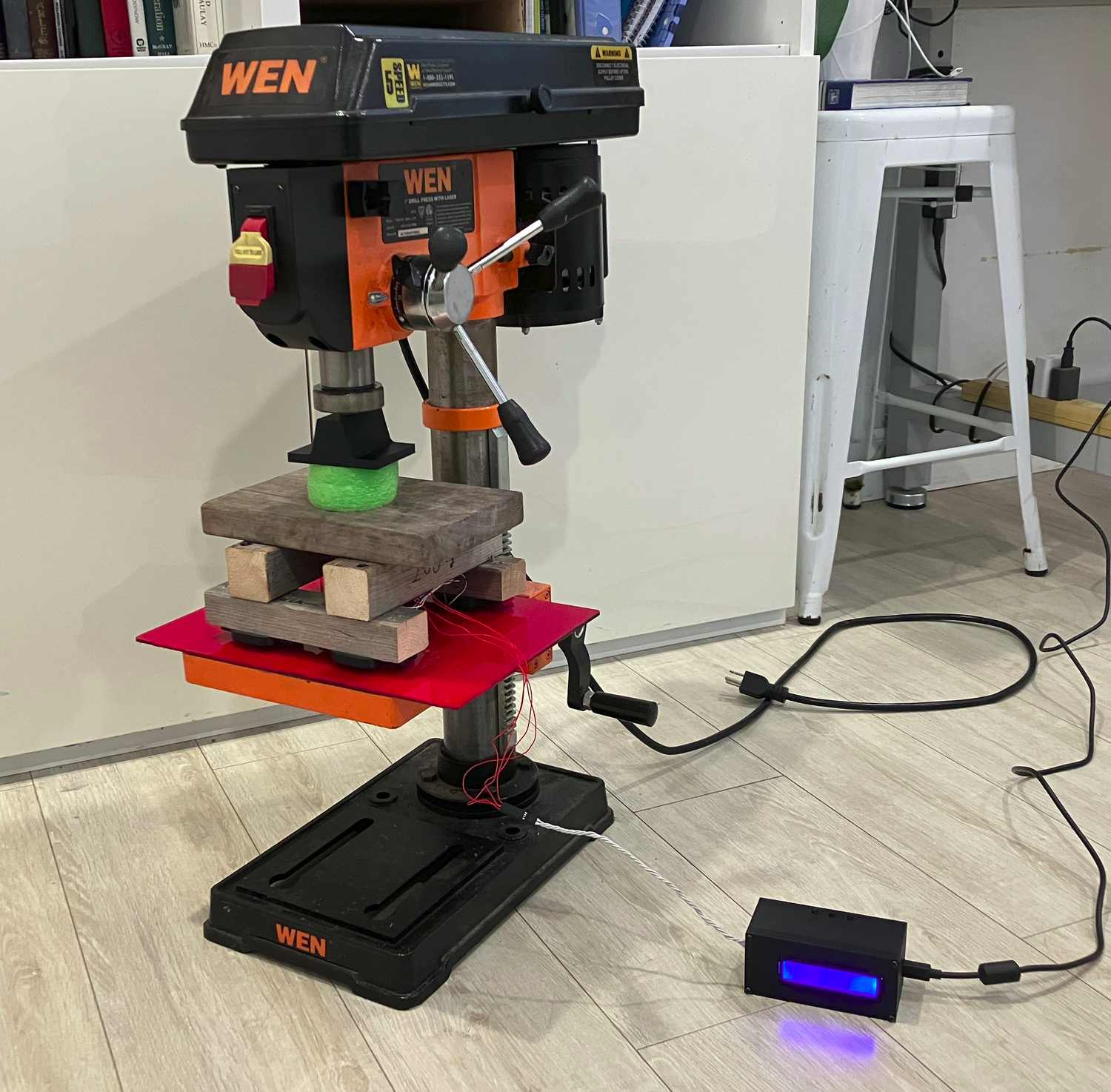
In a recent science fair project, I used a drill press as a press for strength testing. Drill presses are designed to exert fairly high forces while keeping the spindle perfectly straight. Pretty much all drill presses also have some provision to measure downwards travel, allowing the measurement of strain. Additionally, the self-holding Jacobs taper used to mount chucks can be used to mount 3D-printed test fixtures. This all makes drill presses a good choice for a DIY compressive or flexural strength-testing machine that you may already have at home. Unfortunately, since the Jacobs taper will release if you …
-

This was my 2025 Synopsys Science Fair project. Regrettably, I didn’t get to spend as much time as I’d have liked on it. Introduction Clay is an extremely important material because it is cheap (often literally dirt on the ground), durable, and easy to work by pressing, casting, or forming. However, drying clay parts presents challenges since the ideal drying rate is a balance between minimizing drying time and preventing uneven drying. This is particularly important for prototyping or experimentation where many iterations must be made in sequence. In practice, an ideal drying rate is difficult to obtain in ambient…
-

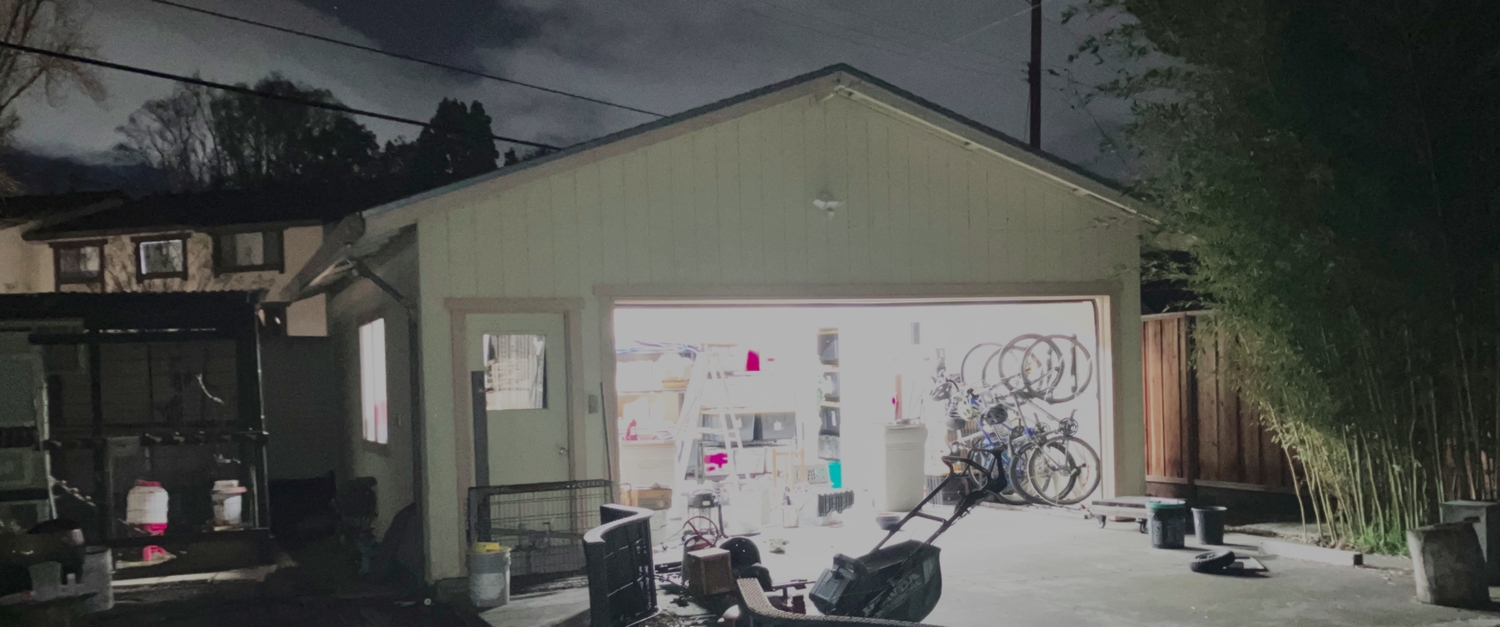
A problem that I’ve had is that I keep forgetting to close the garage door at night, which lets in the elements (and also rats). After being pestered for some time by my parents to find a solution, I finally came up with this. The solution is to turn on the overhead lights any time the garage door is open at night. Since the garage is in plain view of my house, this makes it really obvious when the door is open. Unlike something that automatically closes the door, a solution like this doesn’t need control of the garage door…
-

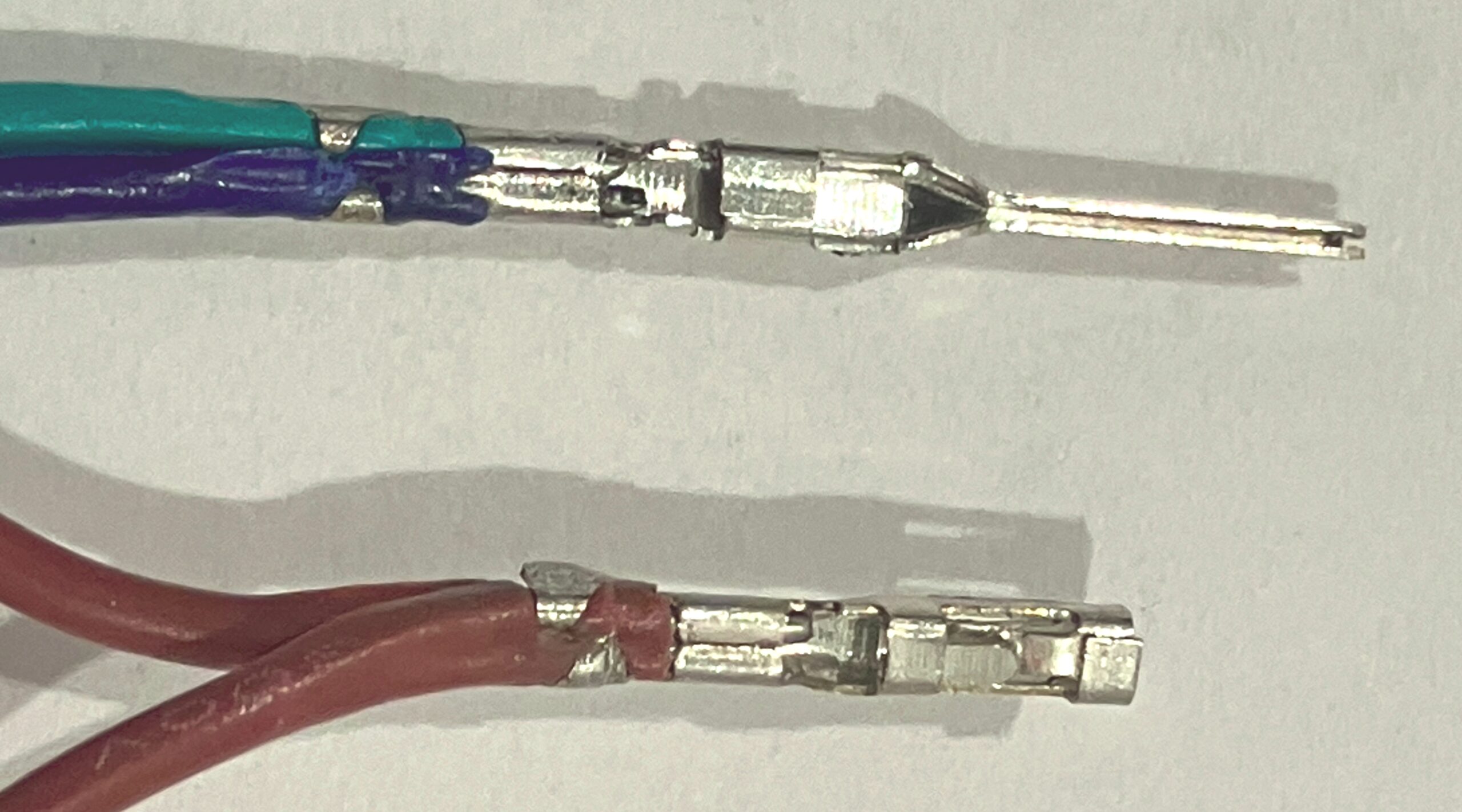
Part of my bicycle-lighting project involved crimping a splitter cable to split the output of the dynamo to the front and rear lamps. I used a DuPont connector for that because I had recently bought, after 4 years of consideration, a proper DuPont crimper. The input and output wires were 24 AWG solid wires with an insulation diameter of about 1.3 mm. A DuPont crimp actually consists of 2 crimps, one onto the stripped wire, and another onto the insulation for strain relief. The biggest challenge when attempting to crimp 2 wires is getting the insulation of both properly into…
-
Recently finding the need to bike home in the dark, and not wanting to regularly charge a battery-powered light, I decided to buy a used bicycle dynamo (for $40) to power a front and rear bike light. The dynamo is a bottom-bracket dynamo, which means it’s meant to be mounted on the bottom bracket (where the pedals are mounted) and is driven by the tire tread. This contrasts with bottle dynamos which are driven by the sidewall of the tire, potentially wearing out the sidewall. There was no space to mount the dynamo on my bottom bracket, but thankfully it…
-

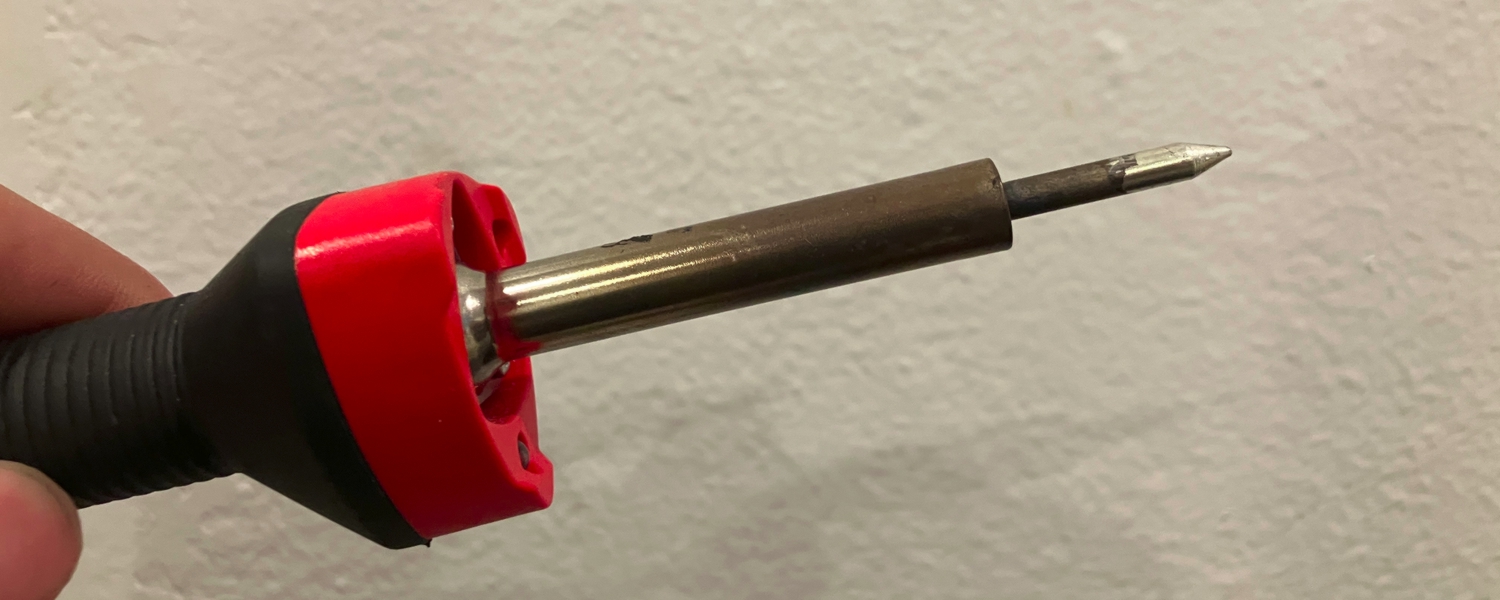
Soldering iron tips are made of copper plated with a very thin layer of iron. Unfortunately, this plating can oxidize if you don’t clean and “tin” it (that is, coat it with solder to protect it), and this can be very annoying because the oxidation is difficult to get off and prevents the solder from wetting the tip. There are a number of ways to get stubborn oxidation off. The recommended way is use some sort of tinning compound designed especially for this purpose, like sal ammoniac. Over the years, I’ve tried a few alternative methods, mostly without success. First…
-

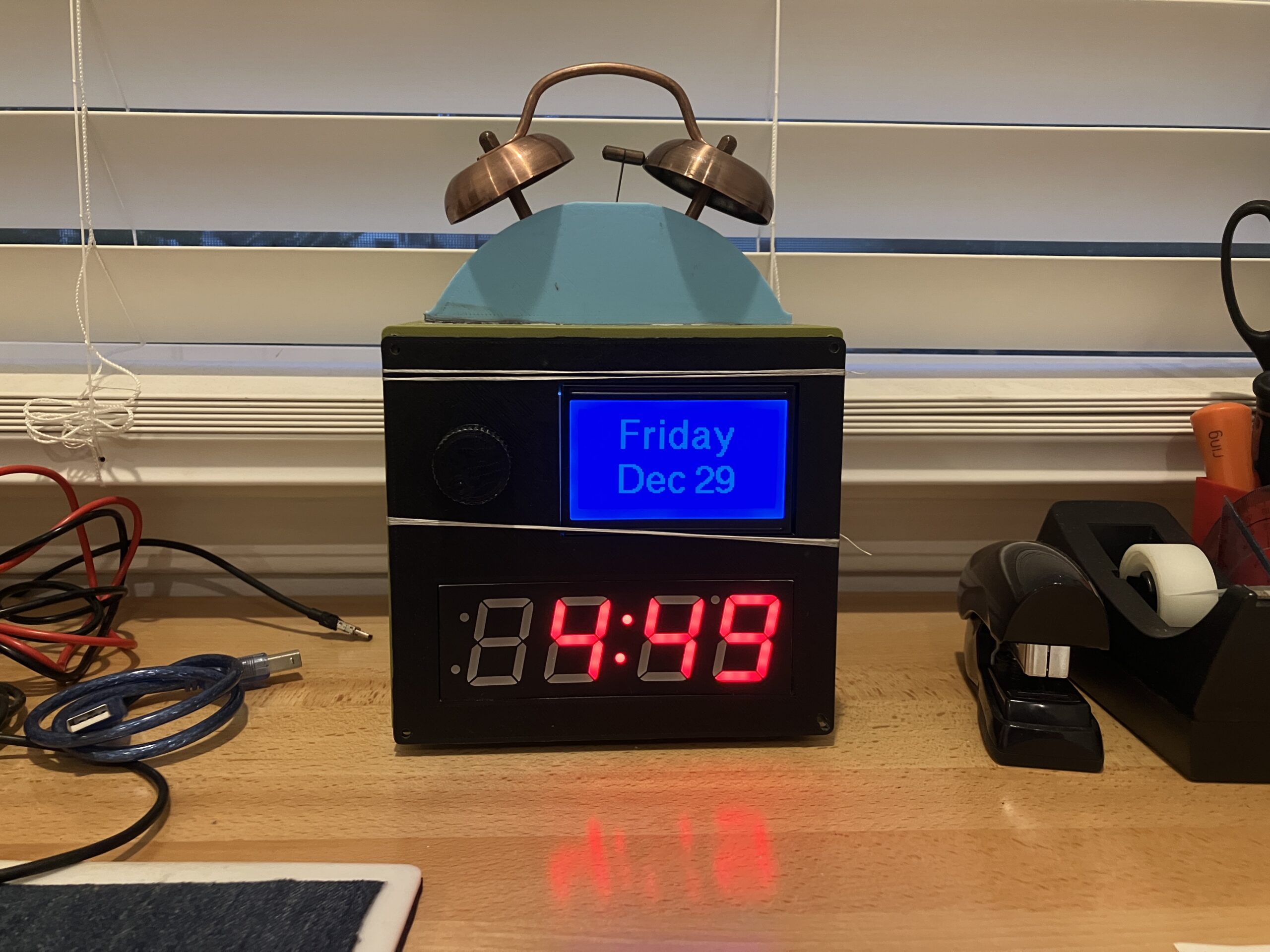
The Idea Is Born In my opinion, an ideal alarm clock should: have an easy-to-read time display, produce a very loud and annoying ring, be able to set alarms with multiple criteria, and, of course, tell the time accurately. Most alarm clocks on the market satisfy no more than two of these criteria: very basic analog alarms are very loud and have good displays, but are technologically very “dumb” and are not exactly accurate, digital alarm clocks also have good displays and decently loud alarms, but are similarly dumb and inaccurate, and “smart” alarm clocks like Amazon’s Echo line are…
-

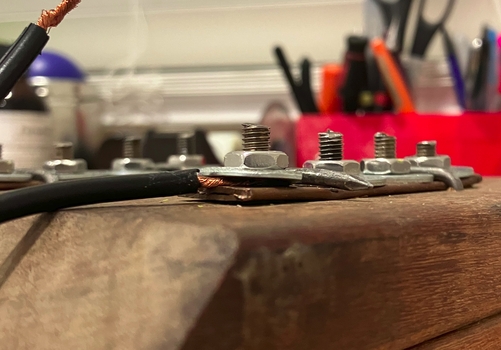
Line AC power is a lot more dangerous than low-voltage DC power. As such, it requires different methods of connecting wires together temporarily. For example, you can use the same wire nuts used for permanent connections, though it’s not particularly fast or repeatable. You could just twist the wires together, but just because you can do something, it doesn’t mean you should. A modest step up in safety is wrapping the twisted wires in electrical tape, but that’s not particularly convenient or safe. You can use things like crocodile clips, but I didn’t have any on hand and many are…